
When it comes to sizing AC units for a house, homeowners often make mistakes that can lead to poor indoor air quality, equipment problems, and uncomfortable living spaces. In this post, we’ll break down the three most common mistakes, explain why they happen, and show you how to avoid them.
1. Bigger Isn’t Always Better
Many homeowners assume that a larger AC unit will cool their home faster and more efficiently. This is a misconception. Installing an oversized system can cause:
- Short cycling (the system turns on and off too quickly)
- Uneven temperature distribution
- High humidity levels
- Increased energy bills and equipment wear
For example, one common scenario involves upgrading from a 3-ton system to a 4-ton system just because the contractor offered it at the same price. The result? A system too big for the home, leading to temperature swings, hot and cold spots, and indoor discomfort.
If you’re trying to estimate the right size, consider BTU per room as a starting point:
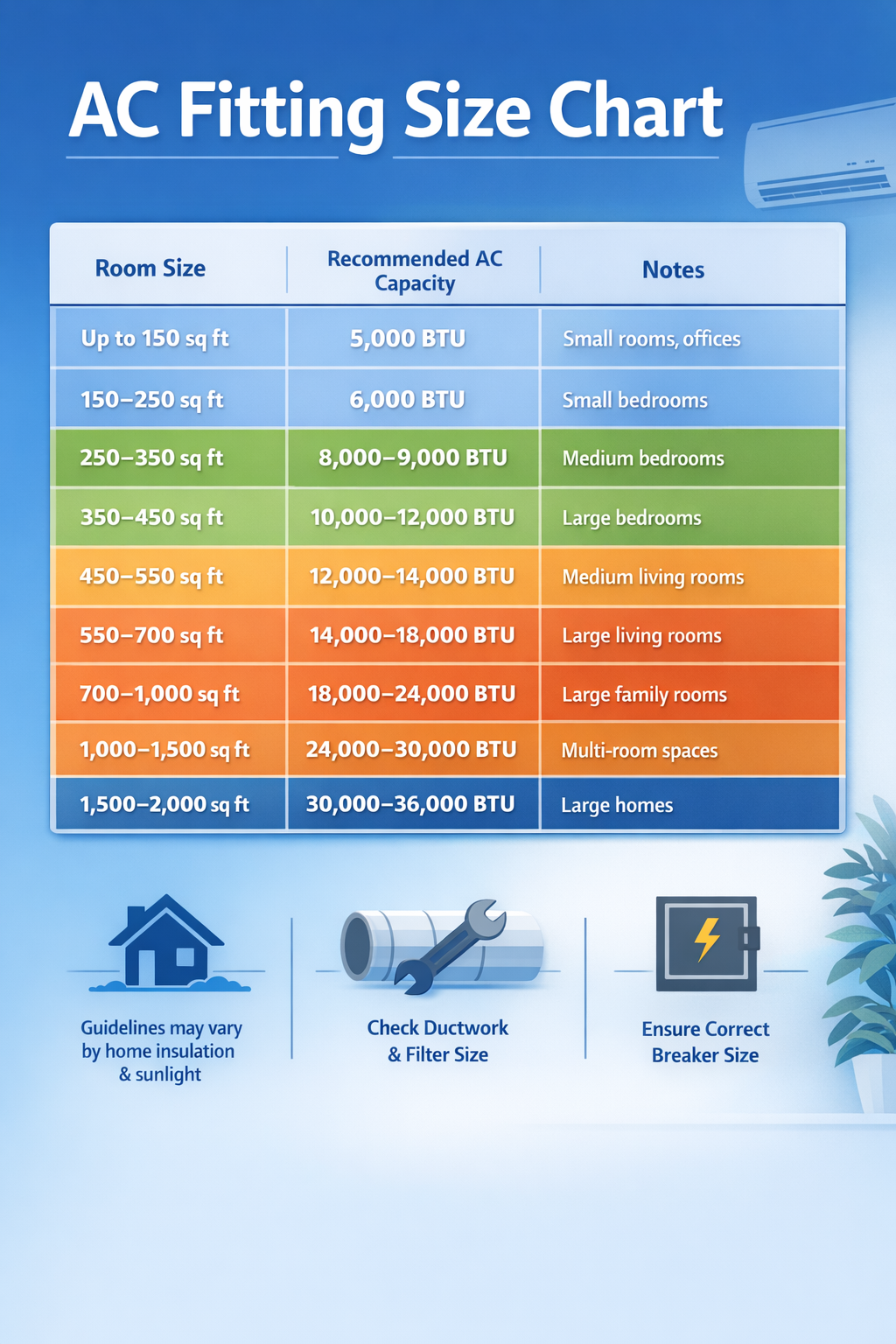
- 9000 BTU AC room size: Suitable for a small bedroom(~350–400 sq ft)
- 14000 BTU AC room size: Ideal for larger bedrooms or medium-sized living areas (~550–650 sq ft)
Check our AC fitting size chart for more details on recommended AC capacity per room.
2. Ignoring Ductwork Size
Even if the AC unit itself is correctly sized, the system won’t perform well if the ductwork isn’t properly matched. Many homeowners focus solely on the equipment and overlook this crucial element.
For instance:
- A 4-ton AC installed in a house with ductwork sized for 3.5 tons will face a bottleneck.
- Reduced airflow increases pressure, decreases efficiency, and can cause humidity issues.
- Over time, this mismatch may damage the equipment or even promote microbial growth in ducts.
To avoid this, always ensure that your ductwork is compatible with your AC unit. Even if your AC is correctly sized, inadequate ducting will make the upgrade pointless. For more tips, check our AC filter size chart and AC capacitor size chart guides.
3. Changes to Your Home Affect AC Performance
Home renovations and efficiency upgrades can drastically change your AC needs. For example:
- Installing new windows
- Adding insulation
- Remodeling or building additions
Even a previously well-sized 4-ton AC system can become oversized if your home becomes more energy-efficient. Oversized systems will short cycle, reduce temperature control, and allow humidity to rise.
Before replacing your AC, discuss any home upgrades or remodels with your contractor to ensure your system is sized correctly. Tools like AC breaker size calculators can also help verify your system’s compatibility with your electrical setup.
4. Ignoring the Risks of Oversized and Undersized AC Units
Another major category of air conditioner capacity mistakes is failing to understand what happens when an AC is too big or too small for the space.
Oversized AC Problems
An oversized AC cools the space too quickly and shuts off before properly conditioning the air. This leads to:
- Short cycling and frequent on/off operation
- Poor humidity control
- Uneven temperatures throughout the house
- Increased wear on components and higher repair costs
These oversized AC problems often make homes feel cold but clammy, especially in humid climates.
Undersized AC Issues
On the other hand, an undersized system runs almost constantly trying to keep up. Common undersized AC issues include:
- Inability to reach the desired temperature
- High energy bills due to nonstop operation
- Excessive strain on the compressor
- Shortened system lifespan
Both scenarios are clear examples of HVAC system sizing errors that could have been avoided with proper planning.
How to Properly Size an AC Unit for Your Home
Proper sizing requires more than a rough rule of thumb. Consider:
- Total square footage of the home
- Number of rooms and occupancy
- Sun exposure and insulation levels
- Existing ductwork and electrical capacity
AC Fitting Size Chart
Check below our AC fitting size chart to determine the appropriate system for your home, or consult a licensed contractor who can perform a detailed load calculation.
Final Thoughts
Correctly sizing your AC unit is critical to comfort, efficiency, and long-term performance. Avoid the common mistakes: don’t oversize, consider ductwork, and account for home changes.
FAQs
Q1. Why is an oversized AC a problem?
An oversized AC can short cycle, cool rooms unevenly, leave humidity behind, waste energy, and increase wear on components, reducing comfort, efficiency, and overall system lifespan.
Q2. Can incorrect ductwork ruin AC performance?
Yes. Poorly designed or damaged ductwork can restrict airflow, reduce efficiency, create uneven cooling, and weaken AC performance, even when the air conditioner itself is properly sized.
Q3. Does AC size affect indoor humidity?
Yes. AC size affects humidity because oversized systems cool too quickly, shutting off before removing enough moisture from indoor air and leaving the home feeling damp.
Q4. Is square footage alone enough to size an AC?
No. Square footage alone is not enough because insulation, ceiling height, windows, layout, occupancy, and sun exposure all affect how much cooling your home actually needs.
Q5. What is the safest way to avoid AC sizing mistakes?
The safest way to avoid AC sizing mistakes is to get a professional Manual J load calculation and have the ductwork inspected for airflow or design problems.
